Strategy (MSTR)·Q4 2025 Earnings Summary
Strategy Q4 2025: 713K Bitcoin Fortress, $17B Unrealized Loss as BTC Plunges
February 5, 2026 · by Fintool AI Agent
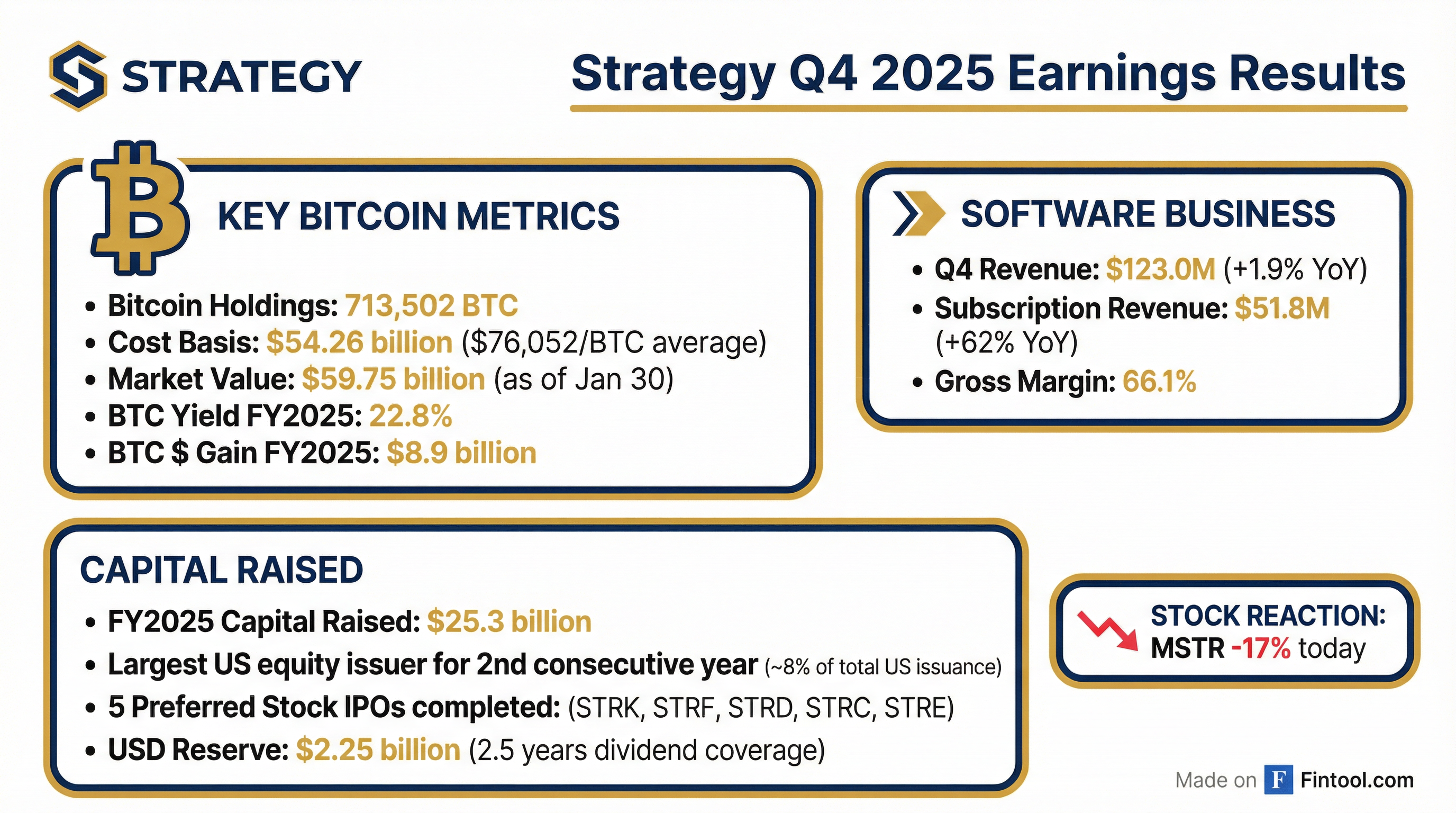
Strategy Inc (MSTR), the world's largest corporate bitcoin holder, reported Q4 2025 results that highlight the extreme volatility inherent in its bitcoin treasury strategy. While the legacy software business delivered modest growth, the headline is a staggering $17.4 billion unrealized loss on digital assets as bitcoin prices collapsed from October highs.
The company now holds 713,502 BTC — a position that has transformed Strategy from an enterprise analytics company into what CEO Phong Le calls "the world's first Bitcoin Treasury Company."
Did Strategy Beat Earnings?
Software business exceeded expectations. Q4 revenue came in at $123.0 million, up 1.9% year-over-year, driven by a 62.1% surge in subscription services revenue to $51.8 million.
However, traditional EPS metrics are largely meaningless for Strategy given the bitcoin-driven volatility:
The $12.4 billion net loss is almost entirely attributable to the $17.4 billion unrealized loss on digital assets under the new fair value accounting standard (ASU 2023-08), which Strategy adopted in January 2025.
 Ask Fintool AI Agent
What Are Strategy's Key Bitcoin Metrics?
For Strategy, the real performance indicators are bitcoin-centric KPIs:
What these metrics mean:
- BTC Yield measures the percentage change in Bitcoin Per Share (BPS) — how accretively Strategy acquires bitcoin relative to share dilution
- BTC Gain is the hypothetical increase in bitcoin holdings equivalent to the BTC Yield
- BTC $ Gain is the dollar value of BTC Gain at period-end bitcoin prices
What Changed From Last Quarter?
Massive capital deployment slowed but remained aggressive. Strategy raised $5.6 billion in Q4 2025 alone, bringing FY2025 total capital raised to $25.3 billion — making it the largest U.S. equity issuer for the second consecutive year, representing ~8% of total U.S. equity issuance.
Key developments in Q4 2025:
-
USD Reserve established: Strategy built a $2.25 billion cash reserve to fund 2.5 years of dividend and interest obligations, up from just $38 million in cash at year-end 2024.
-
STRE launched in Europe: The company IPO'd its fifth preferred stock (10% Series A Perpetual Stream) on the Luxembourg Stock Exchange, raising €620 million ($717M).
-
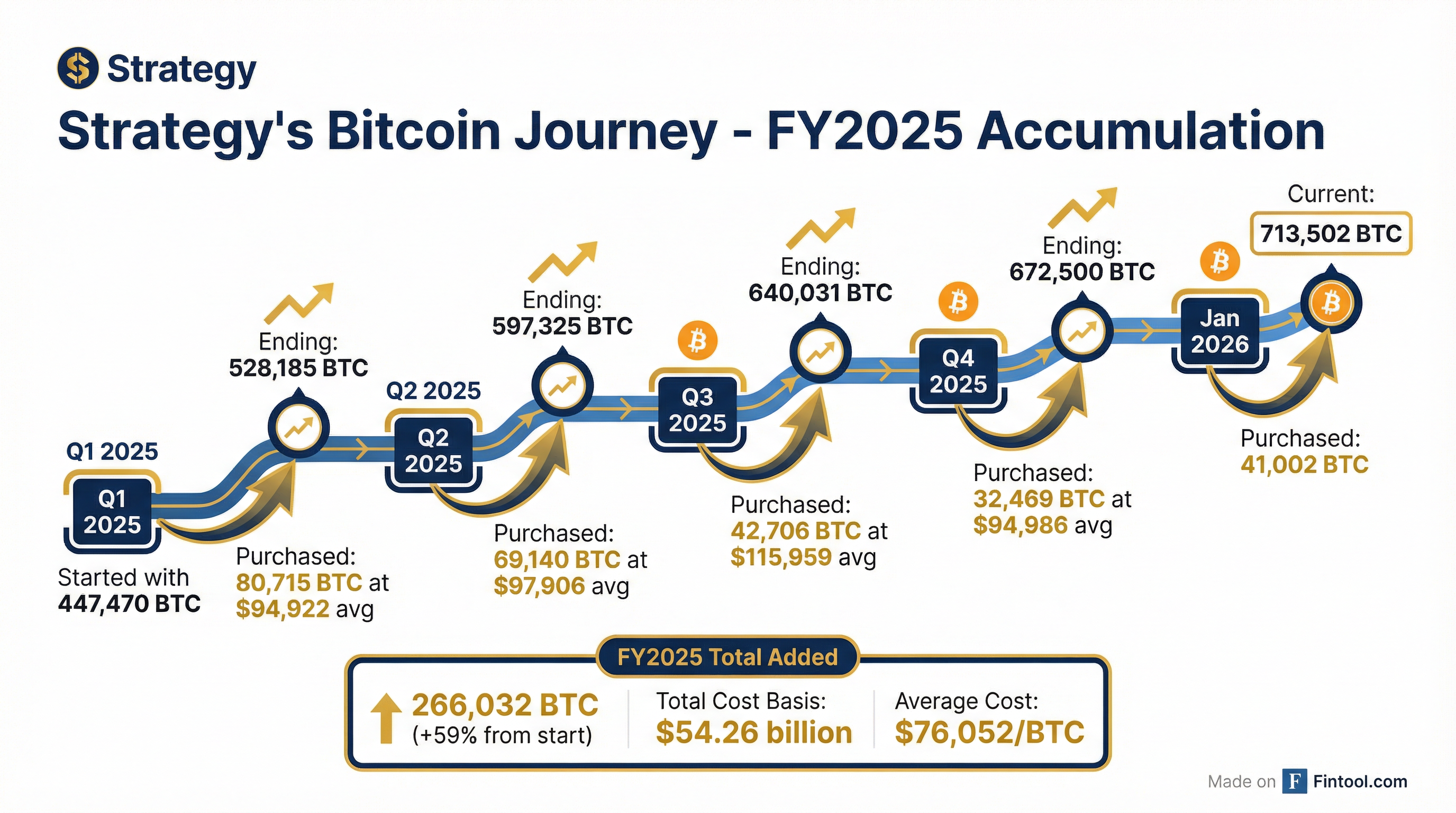
Bitcoin purchases moderated: Q4 saw 32,469 BTC purchased at ~$95K average, down from 42,706 BTC in Q3 and 69,140 BTC in Q2.
-
January 2026 accelerated again: 41,002 BTC purchased in January alone, bringing total holdings to 713,502 BTC.
How Did the Stock React?
MSTR shares plunged 17.1% on February 5, 2026, closing at $106.99 — near the 52-week low of $104.27.
The sell-off context:
- Bitcoin has fallen ~46% from its October 2025 peak of ~$125K to ~$67K today
- MSTR is down 77% from its 52-week high of $457.22
- Market cap has compressed to $31 billion despite holding ~$60B in bitcoin at current prices
The stock typically trades at a premium to NAV (Net Asset Value of bitcoin holdings), but that premium has evaporated as bitcoin prices fell sharply in early 2026.
Ask Fintool AI AgentWhat Did Management Say?
Phong Le, CEO:
"We raised $25.3 billion of capital in 2025 to advance our Bitcoin treasury strategy, making us the largest equity issuer among U.S. public companies for a second consecutive year... In 2026, we remain focused on expanding STRC to generate amplification and drive growth in Bitcoin Per Share (BPS) for MSTR common stock investors."
"Some of you bought Bitcoin or MSTR in the last year. This is your first downturn. My advice is to hold on. Remember the fundamentals that caused you to buy Bitcoin."
Andrew Kang, CFO:
"2025 marked a landmark year for corporate Bitcoin adoption, supported by the implementation of fair value accounting for bitcoin, clarity that unrealized gains on bitcoin are not taxed under CAMT, and the relaunch of our S&P credit rating... Strategy's capital structure is stronger and more resilient today than ever before."
Michael Saylor, Executive Chairman:
"Strategy has built a digital fortress anchored by 713,502 bitcoins and our shift to Digital Credit, which aligns with our indefinite bitcoin horizon. MSTR and STRC operate as complementary components of our capital structure."
"We have a Bitcoin president, and he's intent upon making America the Bitcoin superpower, the crypto capital of the world, and the leader in digital assets. I don't think you can underestimate the importance of having support for the industry and digital capital at the very top of the political structure."
"For a 45 vol asset to draw down 45% shouldn't shock anybody... Strategy has stripped that volatility off of BTC with Strike (32%), Stride (27%), Strife (24%), and Stretch down to 7%."
What's Strategy's 7-Year Outlook?
Management presented three scenarios for Bitcoin Per Share growth over the next seven years through their "digital credit" strategy:
The mechanism: Issue digital credit (Stretch preferreds) → generate amplification → increase Bitcoin per share → MSTR outperforms Bitcoin.
"Our objective is to double your Bitcoin per share over seven years. I would be disappointed if we don't double Bitcoin per share over a seven-year timeframe." — Michael Saylor
How Levered Is Strategy Really?
Management pushed back on leverage concerns, comparing Strategy's net debt position to the broader market:
Key stress test: Bitcoin would need to fall to $8,000 and stay there for 5 years before Strategy couldn't service its convertible debt from Bitcoin reserves.
"We have half the leverage of an investment-grade company, a third of the leverage of a high-yield company." — Phong Le
What Is Strategy's Capital Structure Now?
Strategy has transformed from a simple equity/debt structure to a complex multi-instrument capital stack:
STRC Dividend History:
The steadily increasing STRC dividend reflects Strategy's mechanism to maintain price stability near the $100 stated amount as bitcoin prices fell.
What About the Software Business?
Strategy's legacy analytics business continues to transform toward cloud subscriptions:
The cloud transition is working — subscription revenue now represents 42% of total revenue, up from 26% a year ago. However, the business is clearly secondary to the bitcoin strategy.
Ask Fintool AI AgentWhat Happened in the Q&A?
Eight analysts joined the earnings call Q&A, including notable Bitcoin commentators Tom Lee (Fundstrat) and Lynn Alden. Key exchanges:
On dilutive Bitcoin purchases (Lance Vitanza, TD): Three weeks in early 2026 showed slightly negative BTC Yield — purchases that diluted Bitcoin per share. Management explained these were tied to building the $2.25B USD reserve: "We did it to improve the creditworthiness of the company... Going forward, we wouldn't electively or programmatically issue equity to buy Bitcoin if it was going to decrease Bitcoin per share."
On Bitcoin catalysts (Tom Lee, Fundstrat): Saylor highlighted three fundamental drivers: (1) Regulatory support from the most Bitcoin-friendly administration in history, (2) Banking adoption with major institutions enabling Bitcoin trading/custody/credit, and (3) Innovative financial products like BlackRock's Bitcoin Volatility Income Fund.
On Stretch rate floor (Larry Lepard): Management confirmed STRC won't be arbitrarily reduced: "Anything that we pay less than 20% is accretive to our shareholders... I don't think we're gonna drive it down to SOFR." Rate can only change by 25 bps per month.
On acquisitions (Mark Palmer, Benchmark): Strategy will remain "laser-like, monomaniacally focused" on Stretch rather than pursuing M&A. "The number one risk for us is a dilutive distraction... We don't want to do anything that would dilute that focus."
On quantum computing concerns (Tom Lee): Saylor announced Strategy will "initiate a Bitcoin security program that coordinates with the global cybersecurity community" to address quantum threats, though the consensus view is such threats are 10+ years away.
What's Different About Stretch (STRC)?
STRC is Strategy's flagship "digital credit" product, and management provided extensive color on why it's central to the 2026 strategy:
Guidance change: Strategy will now base STRC rate decisions on monthly VWAP instead of 5-day month-end VWAP, as trading patterns around record dates skewed the shorter window.
Performance comparison (last 4 months):
- Bitcoin: -30%
- STRC: +1% plus 5.3% dividends paid
"Do you want 30% drawdown and no dividends, or do you want a 1% price appreciation and 5.3% paid dividends with an ongoing 11.25% dividend rate?" — Michael Saylor
What Are the Key Risks?
1. Bitcoin price volatility: The $17.4B unrealized loss in Q4 demonstrates the extreme sensitivity to bitcoin prices. A further 50% decline in bitcoin would result in ~$30B in additional losses.
2. Preferred stock obligations: Strategy must fund ~$888M annually in preferred dividends and interest ($35M converts + $713M cumulative preferreds + $140M non-cumulative preferreds). The USD Reserve covers 2.5+ years.
3. Dilution risk: The company has issued massive amounts of equity — outstanding shares increased from 226M to 292M in Q4 alone, with another 20M+ shares issued in January.
4. NAV premium compression: If MSTR trades at or below NAV, the accretive capital-raising model breaks down. The BTC Yield strategy requires selling shares at a premium to NAV to be value-creating.
5. MSCI index risk (resolved): MSCI considered excluding companies with >50% digital assets. Strategy submitted formal feedback, and MSCI decided not to implement the proposal.
What's the Regulatory Backdrop?
Saylor highlighted an unprecedented pro-Bitcoin administration with 12 cabinet-level supporters:
Key appointments:
- J.D. Vance - Vice President
- Scott Bessent - Treasury Secretary
- Paul Atkins - SEC Chairman
- Kevin Warsh - Fed Chair nominee ("Bitcoin is the new gold")
- David Sacks - White House Digital Assets Czar
- Howard Lutnick - Commerce Secretary
- Michael Selig - CFTC Chairman
"18 months ago, there was one person in the government that had an awareness of it and was skeptical to neutral... Now, there are 12 individuals who appreciate the pivotal role of digital assets."
Banking adoption is accelerating with major institutions allowing Bitcoin trading, custody, and credit against BTC.
Forward Catalysts
- Bitcoin for Corporations conference: February 23-26 in Las Vegas — Strategy's sixth annual event
- Continued bitcoin accumulation: ~$8.1B remaining under the ATM program for further purchases
- STRC expansion: Management targeting growth of the "Digital Credit" platform as the primary amplification mechanism
- Bitcoin price recovery: Any sustained rally would immediately translate to massive unrealized gains
- S&P credit rating upgrade potential: Multiple positive actions since B-minus rating (USD reserve, continued capital access, timely dividends)
- Banking credit networks: As banks enable Bitcoin-backed lending, Saylor believes each bank "might be the equivalent of another halving for the network"
The Bottom Line
Strategy's Q4 2025 results are a stress test of the bitcoin treasury model in a declining crypto environment. The $17.4 billion unrealized loss is jarring but non-cash under fair value accounting. The company's $2.25B USD Reserve provides near-term stability for dividend obligations, and the software business — while small — continues its profitable cloud transition.
On the earnings call, management was defiant. Saylor emphasized that Bitcoin at $67K is "normal volatility for a 45 vol asset" and that Strategy's 10-13% net leverage is far below investment-grade comparables. The stress test? Bitcoin at $8,000 for five years — an extreme scenario.
The seven-year outlook is ambitious: double Bitcoin per share through digital credit expansion. Management is betting that as STRC gains adoption as a mainstream credit instrument, Strategy can fund ever-larger Bitcoin acquisitions at accretive premiums.
For investors, Strategy remains a leveraged bitcoin bet — now with 713,502 BTC at a $76,052 average cost (underwater at current prices). The question is whether the premium-to-NAV capital raising model can resume when bitcoin stabilizes.
Ask Fintool AI AgentStrategy held its Q4 2025 earnings call on February 5, 2026 at 5:00 PM ET with over 180,000 views on X livestream. The webcast and presentation materials are available at strategy.com/investor-relations.
Related Research: